
British Science Week: Curiosity, What’s Your Question?
- kateguthrie3
- Feb 23
- 3 min read
From ‘Why?’ to ‘What If?’
Most of us can remember at least one moment of being completely stumped by a question from a learner, no matter our subject. It can happen at any time - five minutes before the bell, just when you think you’ve explained a concept brilliantly, or just as you’re finalising a conclusion. Why do shadows move? Where does the wind come from? If plants are alive, do they get tired? And while these questions may stump us for a moment, they are the sign that we’re doing something right.
These questions aren’t asked to put us on the spot (even if it feels that way). They’re evidence of something far more important: a curious mind that is actively trying to make sense of the world. In science, that moment - before the answer, before the explanation, before the worksheet, the discussion and the plenary - is where the learning actually begins. And if you’ve got your learners thinking and asking, you’re on the way to supporting their curiosity and creating links to cement those ideas. You’re also seeing the evidence of creating a learning environment where your young people feel safe to wonder and ask.
Curiosity is not a distraction from learning in science; it is the driving engine of it. And when we pause to ask, “What’s the question behind this question? What if…?” We start to see science not as a collection of facts to deliver, but as a way of thinking that we are privileged as educators to nurture and encourage.
British Science Week 2026 is all about embracing curiosity and emphasising that, without it, we would never advance - and that it’s ok to not know and to question. That space between knowing and not-knowing, and how we get from one to the other, is where learning really happens and where we build resilience in our learners.
The following resources have been created to give you options for building curiosity in your learners, in science and beyond:
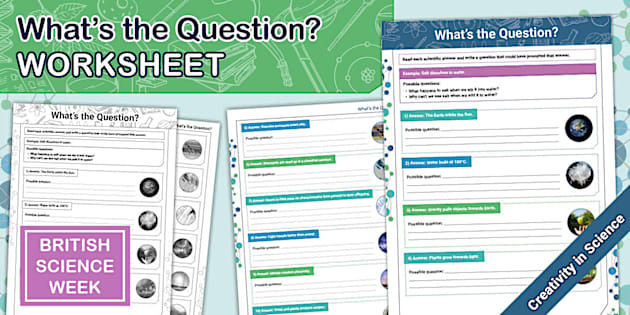
With this resource, learners are challenged to think critically by creating questions that correspond to provided scientific answers. It's a fantastic way to promote scientific thinking and creativity, perfect for British Science Week 2026 and beyond.

This resource could be used for British Science Week 2026 or at any time of year as a research activity for BGE learners. It features a captivating slideshow showcasing scientific discoveries and innovations from various countries, prompting learners to ponder what intrigued people and the impact of these findings. It also has an accompanying worksheet.

Ready to dive into the fascinating world of space and the search for life beyond Earth with our 'Curious About: Physical Conditions for Life' worksheet? This resource is designed to spark curiosity and engage Third Level BGE learners in exploring the criteria for life in the universe.

With Scientific Curiosity: Blether Stations, you'll enjoy a resource that not only aligns with the theme of 'Curiosity: What’s Your Question?' for British Science Week 2026, but also encourages learners to explore scientific concepts in a fun and interactive way that can be used any time of the year.

All of these British Science Week 2026 resources can be used to encourage a desire to know more, build trust and enquiry skills, normalize uncertainty and create a space to build resilience - ultimately showing our learners that curiosity is the key and it’s essential to embrace the ‘what ifs’!
Comments